RIVET / 3.0

Out now · Microsoft Store · Windows 10/11

See what your PC is doing.

Rivet is a free Windows app that shows what's running on your PC — processes, services, startup apps and hardware — explains each one in plain English, and lets you change it safely. Every change is previewed first and written to a history you can undo where it's supported. It includes an AI assistant that runs on your own machine.

Get it from the Microsoft Store

Same idea. Different machine.

v2.1 was one PowerShell file that drew a HUD in a console window. 3.0 is a compiled desktop app with a real window, a real navigation model, and a safety net under every button.

01 · A compiled app, properly packaged

WPF on .NET 10, shipped as one signed MSIX package from the Microsoft Store. No unblocking, no prerequisites, no console window pretending to be a UI.

2.1: 2.1 single file → 3.0: Rivet.exe

02 · A sidebar instead of typed verbs

Overview, Ask Rivet, Checkup, Startup, Cleanup, Processes & services, Tweaks, History, Guard & Restore, Settings — one window, no submenus.

2.1: 35 verbs → 3.0: one sidebar

03 · A history you can undo from

Every action is previewed and recorded. Windows settings, startup apps and service start types can be undone after a restart; stopping or restarting a service while Rivet is open; cleanup and process kills not at all — and History says which.

2.1: fire and forget → 3.0: history + undo

04 · Real system control

Services, scheduled tasks, startup entries and boot impact through CIM and the task scheduler — not screen-scraped output.

2.1: read-mostly → 3.0: read + write

05 · The assistant runs locally

Ask uses a local endpoint if you already run one — Ollama or Foundry Local — and otherwise its own bundled runtime. Either way nothing leaves the device.

2.1: bring your own key → 3.0: on-device · offline

06 · Store licence, one purchase

Live on the Microsoft Store with a 14-day trial (once per computer) that runs the full app. Licence resolves offline once activated.

2.1: itch.io → 3.0: MS Store · live

One window, no submenus.

The sidebar is the whole app. Each module owns one job and shares the same action log.

Overview

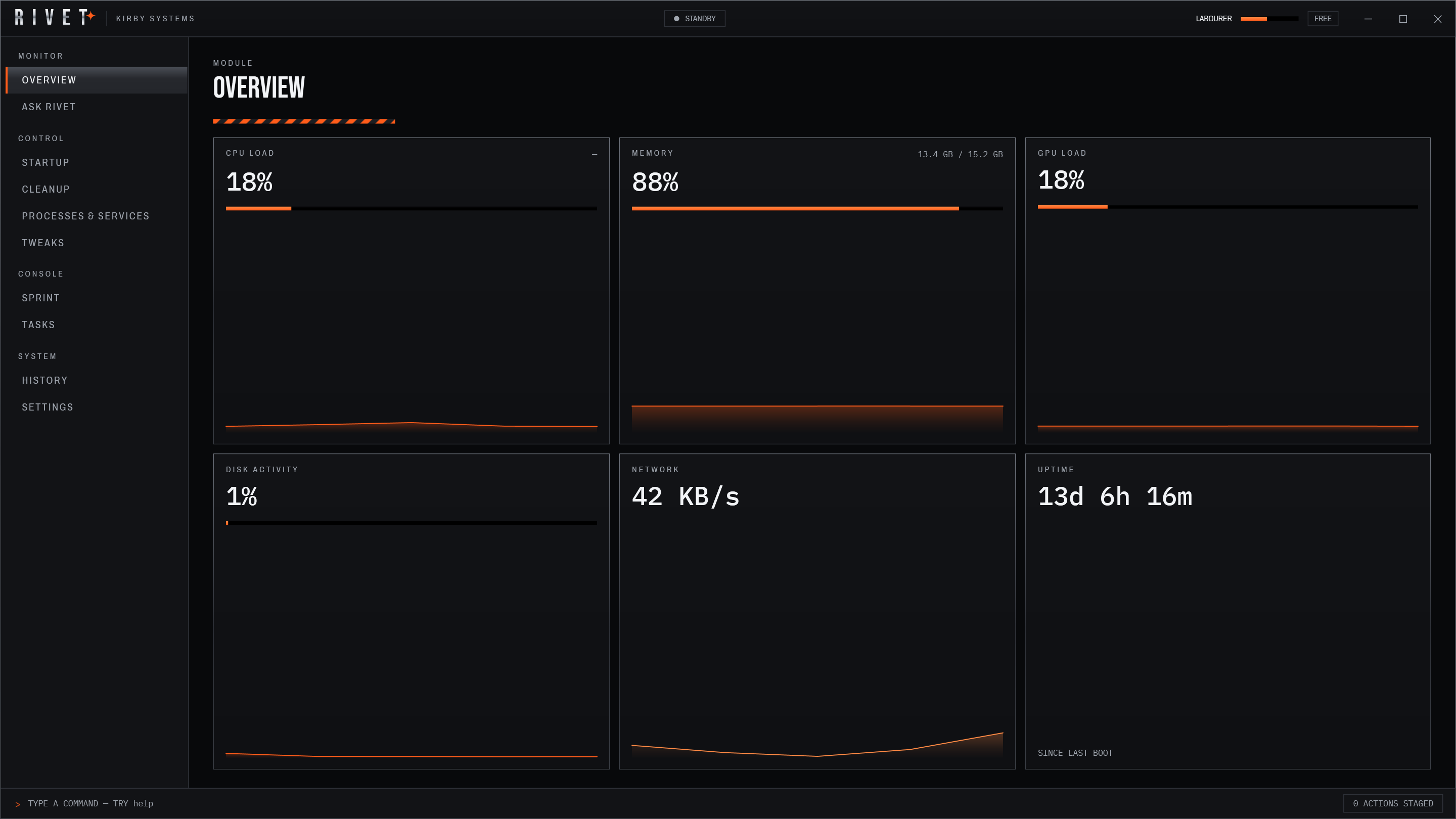
CPU, GPU, memory, disk and network sampled through CIM and performance counters, drawn as sparklines that keep 60 seconds of history. Processes arrive grouped, so twelve browser helpers read as one row you can act on.

  • Rolling series per counter
  • Grouped process tree
  • Kill a whole group at once
  • Sortable by CPU, memory, I/O

Processes & services

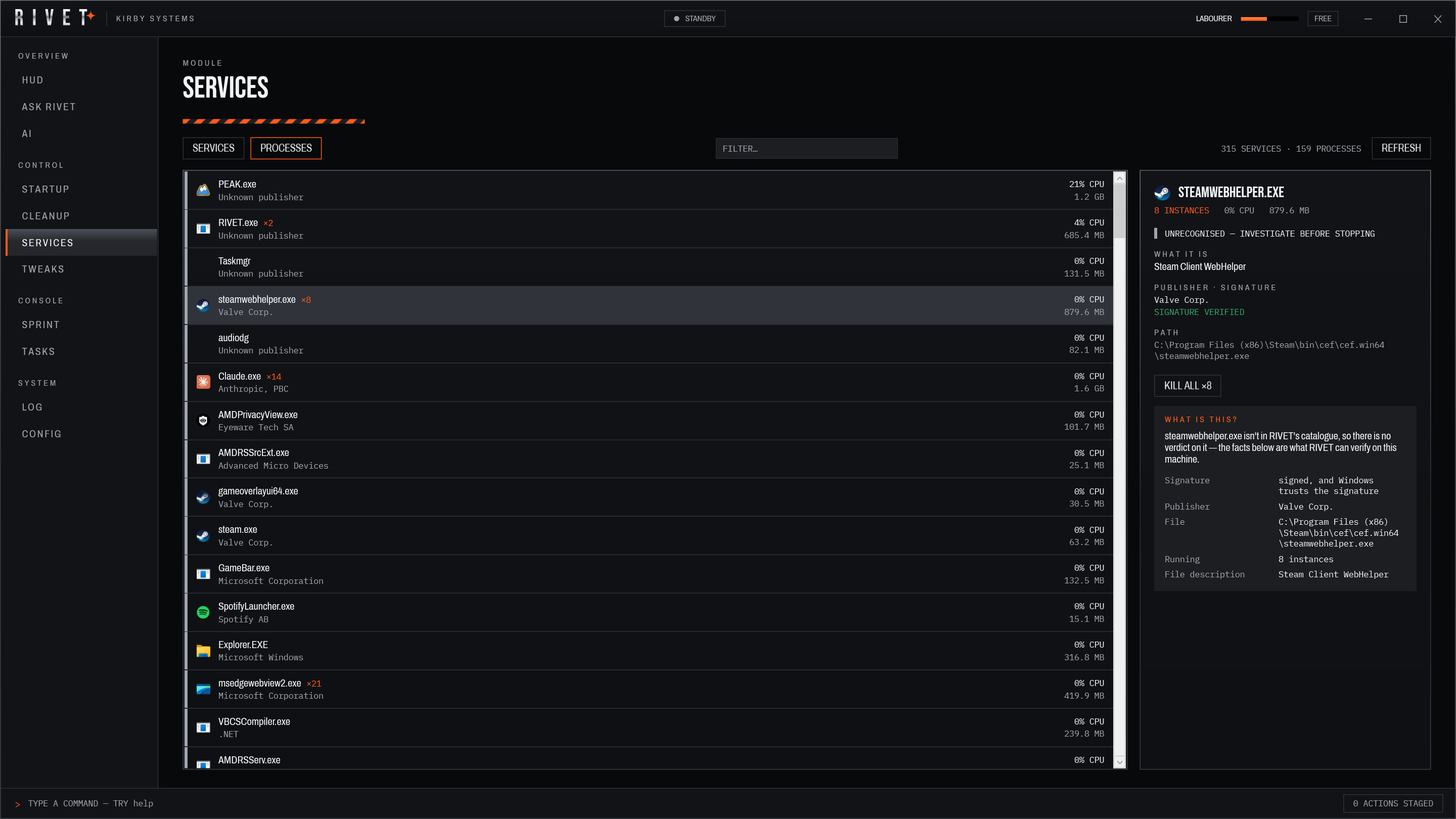
Processes and services in one place. Stop, restart or re-target a service start type without opening three consoles — every change is previewed first, and can be undone while Rivet is open.

  • Process + service tabs
  • Stop / restart service
  • Change start type
  • Signature check on binaries

Startup

Everything that runs at login, with a measured boot impact next to it. Disable an entry, or delay it by a few minutes with a scheduled task so login stays fast without losing the app.

  • Boot impact sampling
  • Apps and services tabs
  • Delay instead of disable
  • Reads StartupApproved state

Cleanup

A scanner that reports what it found before it touches anything: temp trees, caches, update leftovers, dumps, the Recycle Bin. You pick the rows. Deleted files are deleted — cleanup is the one thing that can't be undone, and it says so.

  • Scan-then-clean, never silent
  • Per-row sizes
  • Nothing selected by surprise
  • Irreversible, and labelled as such

Checkup

A 30-second checkup of what is slowing the PC, with the evidence behind every finding — measured counts, never an estimated saving. Free applies one fix per checkup; Pro fixes everything recommended in stages, each undoable on its own.

  • Evidence for every finding
  • One fix free per run
  • Pro: staged fix-all
  • Each fix undoable

Tweaks

A catalogue of Windows settings with plain-English descriptions of what each one does and what it costs. Apply the recommended set, or restore one tweak, one group, or everything.

  • Documented tweak catalogue
  • Previous value captured before the write
  • Undo survives a restart
  • Restore one / group / all

Ask Rivet

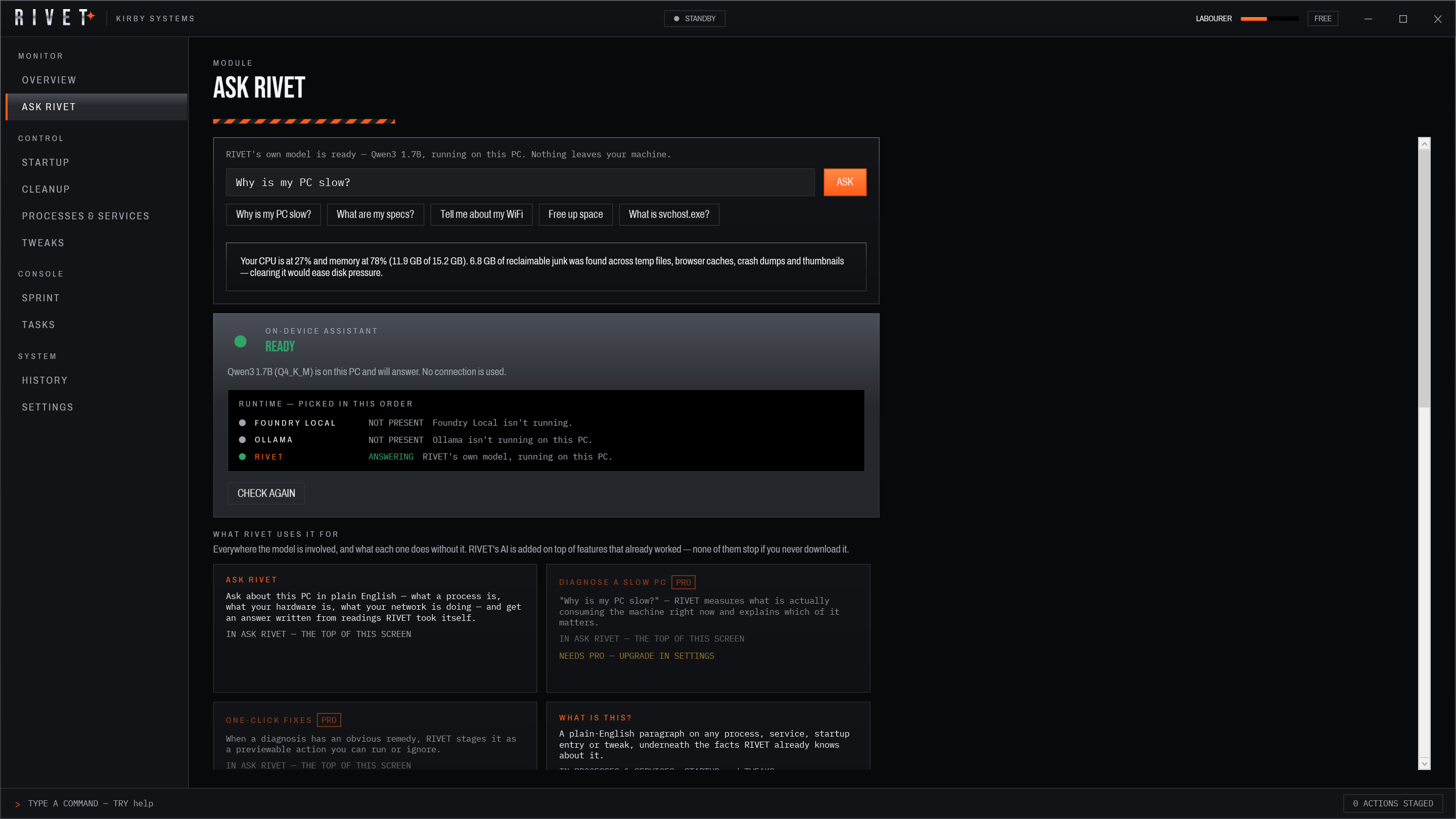
An assistant that runs on your PC: Qwen3-1.7B through llama.cpp, downloaded once when you say so. Uses Foundry Local or Ollama instead if you already run one. Without any model it still answers in keyword mode from the same real readings.

  • Bundled runtime, optional download
  • Foundry Local / Ollama if present
  • Answers read live system state
  • Model status and controls on the same screen

History

Every action written down, with what changed. Windows settings, startup apps and service start types keep their previous value on disk and can be undone after a restart; stopping or restarting a service can be undone while Rivet is open; cleanup and ending a process can't be undone. Each row says which.

  • Full action history
  • Undo where supported
  • Tweaks: undo after restart
  • Refuses to overwrite a value that changed since

Guard & Restore

After a Windows update, a list of what the update changed — startup apps, services, scheduled tasks, Store apps — with a Restore for each. Guard (Pro) puts back the choices you protect when an update resets them, and only tells you about changes you made yourself.

  • What the update changed
  • Restore per item
  • Guard re-applies (Pro)
  • Roll back to a date (Pro)

Settings

Language, theme, motion, licence state and permissions in one panel. Ten languages, eight themes — four with their own layout — and a permission surface that says exactly what each feature touches.

  • 10 languages
  • 8 themes
  • Licence and trial state
  • Permission surface

Questions before installing

Is it safe? What happens if a change breaks something?

Every change is previewed before it runs and written to History. Windows-settings tweaks keep their previous value in the history file and can be undone even after Rivet is closed and reopened — Rivet re-reads the setting first and refuses if something else changed it since. Service and startup changes can be undone while Rivet is open.

Cleanup deletes files and ending a process ends it; neither can be undone, and Rivet says so before you confirm. The package is a signed MSIX distributed through the Microsoft Store, so it passes Store certification on every update.

Does it need administrator rights?

No — and it never asks. Rivet runs as a standard user; everything on every screen works that way.

Anything that would need admin rights — stopping a protected service, a machine-wide setting — fails with a clear message rather than prompting for elevation. Settings has a permission surface listing every capability the app uses.

Does Ask RIVET send anything off my device?

No. The model is Qwen3-1.7B running through llama.cpp on your own hardware — there is no account, no API key, no server to talk to, and no telemetry anywhere in the app. If Foundry Local or Ollama is already running on your PC, Rivet uses that instead.

The only network request Rivet itself makes is the one-time download of the model file itself (about 1.3 GB), on demand, if you choose to use Ask. Once it is on disk the feature works with the machine offline. Prefer to skip that entirely? RIVET XP makes no network connections at all. Full detail on the innovation page.

What's free, and what do I pay for?

Installing is free and everything is unlocked for 14 days on your own hardware, once per computer — reinstalling doesn't restart it. Nothing is crippled or watermarked during it.

After that Free keeps working — overview, processes and services, startup, the privacy, context-menu and visual-effects tweaks, basic cleanup, Ask Rivet's identify-and-explain, history and undo. Pro adds slow-PC diagnosis with staged fixes, the full tweak catalogue, advanced cleanup, unlimited startup delays and the change digest, as a one-off $4.99 purchase through the Microsoft Store — shown in your local currency. No subscription.

Which Windows versions does it run on?

Windows 10 version 2004 or newer, and Windows 11 — x64 only. The runtime ships inside the package, so there are no prerequisites to install and nothing to unblock.

Skip to content
RIVET
Rivet 3.0 · loading
HOME 3.0 XP v2.1
RIVET
Out now · Microsoft Store · Windows 10/11

See what
your PC
is doing.

Rivet is a free Windows app that shows what's running on your PC — processes, services, startup apps and hardware — explains each one in plain English, and lets you change it safely. Every change is previewed first and written to a history you can undo where it's supported. It includes an AI assistant that runs on your own machine.

▸ Get RIVET — free
Microsoft Store· v3.6.0· Changelog

Want it lighter? Rivet-XP has no AI and makes no network connections at all. Need an older build? All versions.

Freeto install 0cloud calls 0telemetry Undowhere supported
RIVET 3.0HUD · simulated
{{ n.label }}
{{ t.k }} {{ t.v }}%
Processes · groupedlive
{{ p.name }}{{ p.mem }}{{ p.cpu }}
SAMPLE
TIER · {{ rankLabel }}
native WPF◆ signed MSIX◆ no prerequisites◆ undo where supported◆ local assistant, no cloud◆ imports your v2.1 data
Actual screenshots · not mockups

This is what you get.

Captured from Rivet v3.6.0 running on Windows 11. No composites, no render mockups — the window you install looks like this.

RIVET's HUD module: CPU at 42%, memory at 97% of 15.2 GB, GPU at 60%, plus disk activity, network throughput and 11 days of uptime, each with a live sparkline.
HUD · live counters, 60s of historymodule 01
The Ask RIVET module answering a question about system state, with the on-device model named in the header and a proposed fix the user can confirm.
Ask RIVET · on-devicemodule 08
The process list grouped by application, showing memory and CPU per group so a dozen browser helpers read as one actionable row.
Processes · groupedmodule 02
What changed

Same idea. Different machine.

v2.1 was one PowerShell file that drew a HUD in a console window. 3.0 is a compiled desktop app with a real window, a real navigation model, and a safety net under every button.

{{ c.num }}→

{{ c.title }}

{{ c.body }}

2.1 · {{ c.old }}3.0 · {{ c.now }}
One window, no submenus · click through

One window, no submenus.

The sidebar is the whole app. Each module owns one job and shares the same action log.

{{ active.title }}

{{ active.tag }}

{{ active.body }}

+{{ pt }}
The headline feature

Nothing it does
is permanent.

Every action Rivet takes is previewed and written to History. A Windows-settings tweak records the value that was there before — its type, and whether it existed at all — in the history file, so it can be undone even after Rivet is closed and reopened. Before putting it back, Rivet checks the value is still the one it set; if something else changed it since, it says so and leaves it alone.

Stopping a service or changing a startup app can be undone while Rivet is open. Cleanup deletes files and ending a process ends it — neither can be undone, and Rivet tells you before you confirm. If a change you can undo broke something, hit Revert last.

previous value kept conflict check signature verify permission surface
History · simulated{{ liveCount }} undoable
{{ r.time }} {{ r.text }}
Simulated log — try it, the buttons work.
Ask · simulated demo — canned answers, not a live model

It knows your machine.
It runs on your machine.

In the app, Ask reads live counters, the process tree, startup impact, services and your history — then answers from those readings and, on Pro, proposes a fix you confirm with one click. The model is Qwen3-1.7B running through llama.cpp on your own PC, downloaded once when you choose to; if Foundry Local or Ollama is already running, Rivet uses that instead. No account, no key, nothing leaving the device. The demo below is scripted — it shows the shape of an answer, not a live model.

Ask
{{ endpointLabel }}{{ endpointState }}
{{ m.name }}
{{ m.text }}
{{ m.actNote }}
reading system state…
ask ▸
{{ c.tag }}

{{ c.title }}

{{ c.body }}

What it can see, live
{{ s.k }}{{ s.v }}
Straight answers

The things
you'd want to ask
before installing.

RIVET is a system-level utility. You should be suspicious of it. Here is everything we'd want to know.

→ Full technical notes
Is it safe? What happens if a change breaks something?

Every change is previewed before it runs and written to History. Windows-settings tweaks keep their previous value in the history file and can be undone even after Rivet is closed and reopened — Rivet re-reads the setting first and refuses if something else changed it since. Service and startup changes can be undone while Rivet is open.

Cleanup deletes files and ending a process ends it; neither can be undone, and Rivet says so before you confirm. The package is a signed MSIX distributed through the Microsoft Store, so it passes Store certification on every update.

Does it need administrator rights?

No — and it never asks. Rivet runs as a standard user; everything on every screen works that way.

Anything that would need admin rights — stopping a protected service, a machine-wide setting — fails with a clear message rather than prompting for elevation. Settings has a permission surface listing every capability the app uses.

Does Ask RIVET send anything off my device?

No. The model is Qwen3-1.7B running through llama.cpp on your own hardware — there is no account, no API key, no server to talk to, and no telemetry anywhere in the app. If Foundry Local or Ollama is already running on your PC, Rivet uses that instead.

The only network request Rivet itself makes is the one-time download of the model file itself (about 1.3 GB), on demand, if you choose to use Ask. Once it is on disk the feature works with the machine offline. Prefer to skip that entirely? RIVET XP makes no network connections at all. Full detail on the innovation page.

What's free, and what do I pay for?

Installing is free and everything is unlocked for 14 days on your own hardware, once per computer — reinstalling doesn't restart it. Nothing is crippled or watermarked during it.

After that Free keeps working — overview, processes and services, startup, the privacy, context-menu and visual-effects tweaks, basic cleanup, Ask Rivet's identify-and-explain, history and undo. Pro adds slow-PC diagnosis with staged fixes, the full tweak catalogue, advanced cleanup, unlimited startup delays and the change digest, as a one-off $4.99 purchase through the Microsoft Store — shown in your local currency. No subscription.

Which Windows versions does it run on?

Windows 10 version 2004 or newer, and Windows 11 — x64 only. The runtime ships inside the package, so there are no prerequisites to install and nothing to unblock.
Microsoft Store · available now

Buy it once.
Own it after.

Rivet ships as a signed package with a Store licence — install it on your devices, no subscription, no telemetry. A 14-day trial (once per computer) runs the whole app so you can see it on your own hardware before deciding on Pro.

Windows 10 2004+ · x64signed MSIXfree · Pro $4.99 one-off
RIVET 3.0 app tile
RIVET
v3.6.0 · x64
Changelog
RIVET v3.6.0 Free trial · no account
▸ Get it free